Treatments · 4 min read
Does Botox Hurt? What the Appointment Actually Feels Like
The most common question I am asked by first-time patients is not about results. It is about the needle. Here is the honest answer.

Almost everyone who books a first neuromodulator appointment is more nervous about the injections than about the outcome. That is reasonable. Nobody enjoys the idea of needles in their face. So rather than reassuring you, I will describe exactly what happens.
The needle
The needle used for Botox, Dysport or Xeomin is among the finest used in medicine, typically 30 to 33 gauge. That is thinner than the needle used to draw blood and thinner than most insulin needles. The volume injected at each point is tiny, usually a few hundredths of a millilitre, so there is no sensation of pressure or filling.
Most patients describe each injection as a brief pinch, similar to a plucked eyebrow hair, lasting about a second. The forehead and between the brows are the least sensitive areas. Around the eyes and the upper lip are slightly more sensitive. On a scale where a flu shot is a five, most people rate this a two or three.
How long it takes
The injections themselves take three to five minutes for a standard treatment of the upper face. The appointment is longer than that because assessment comes first: I ask you to frown, raise your brows and smile so I can see how your muscles actually move, and I mark the points before I inject. A first appointment is usually twenty to thirty minutes, most of it conversation.
Numbing
Topical numbing cream is rarely necessary for neuromodulators and I do not routinely use it, because it adds twenty minutes and makes very little difference to a one-second pinch. Ice applied for a few seconds before each area works well for patients who are anxious. If you know you are needle-phobic, tell me when you book and we will plan for it.
Immediately afterwards
You will see small raised bumps at each injection point, like mosquito bites. These are the fluid itself and they settle within fifteen to thirty minutes. A pinpoint of redness may last an hour. Occasionally a small bruise appears, most often near the eyes where the blood vessels are close to the surface, and it fades over a few days. You can drive, return to work and be seen in public straight away.
For the first four hours, avoid rubbing the area, lying flat, or vigorous exercise, so that the product stays where it was placed. After that, there are no restrictions. Makeup can go on after a couple of hours.
The part people forget to ask about
Nothing happens on the day. Neuromodulators take three to five days to begin working and about two weeks to reach full effect. If you leave the clinic looking exactly the same, that is correct. The review appointment at two weeks is where small adjustments are made if needed.
Common questions
How painful is Botox on a scale of one to ten?
Most patients rate each injection between two and three out of ten, describing it as a brief pinch lasting about a second. The forehead is the least sensitive area; around the eyes and the upper lip are slightly more sensitive.
Do you use numbing cream for Botox?
Not routinely. The needle is very fine and each injection takes about a second, so topical anaesthetic adds time without much benefit. Ice for a few seconds before each area is effective for anxious patients, and can be arranged if you ask when booking.
How long does a Botox appointment take?
The injections take three to five minutes. A first appointment is usually twenty to thirty minutes in total because it includes assessment, marking and a conversation about what you want to achieve.
Can I go back to work after Botox?
Yes. Small bumps at each injection point settle within about thirty minutes and any pinpoint redness fades within an hour. Avoid rubbing the area, lying flat or strenuous exercise for four hours, then resume everything as normal.
Will I see results on the same day?
No. Neuromodulators begin working after three to five days and reach full effect at about two weeks. Leaving the clinic looking unchanged is expected.
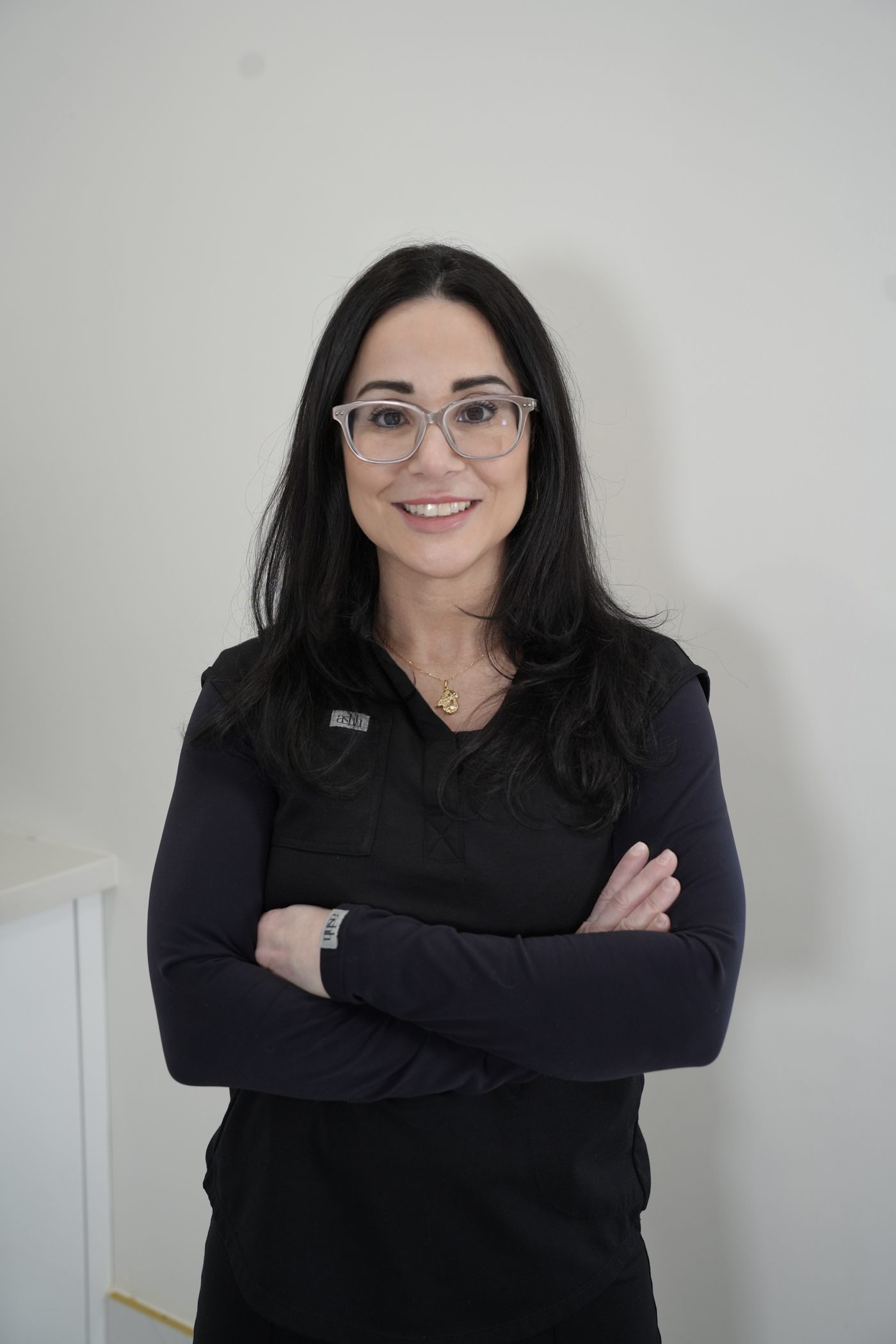
Dr. Mazzuca is a licensed physician practising medical aesthetics in Markham, Ontario, with additional training in cosmetic medicine, facial anatomy, women's health, and longevity medicine. Every treatment at the clinic is performed by her personally. Her registration can be verified through the College of Physicians and Surgeons of Ontario.
Written and medically reviewed by Dr. Monique Mazzuca, MD, CCFP. Published September 11, 2026.
This article is general information, not medical advice, and it is not a substitute for an in-person assessment. Results vary between patients, and every treatment carries risks that are reviewed with you before you consent. Suitability is determined by Dr. Mazzuca at your consultation.
More from the Journal


